
Data-Driven Modeling of Dynamic Processes

Data-Driven Modeling of Dynamic Processes

With Blueriq 19, we are introducing a fundamentally new way of modeling and executing dynamic processes. This new approach was developed to build complex case management solutions faster, make them easier to understand, and simplify their management—all without compromising flexibility or functionality.

Learn more about dynamic processes (DCM)
Available in Blueriq 19

With the new modeling approach, you only define what a process needs to achieve, not how it does so. It’s no longer about mapping out every step, but about functionally describing the desired outcome. This creates a way of working that better aligns with both business and IT.

Curious to see what that looks like? Then watch the video on the right.

Less complexity in design

No more hidden logic or implicit agreements, but clear, recognizable building blocks.

Faster implementations

Because the model is more closely aligned with the business logic, there is less need for coordination between teams, which means projects go live faster

Future-proof solutions

Processes that easily adapt to changing business requirements and are easy for agents to understand.

From Technical Modeling to Goal-Driven Modeling

Instead of focusing on the technical details of process flows, business engineers now primarily model what a business needs to achieve. The model describes the goals of a process, the information required to achieve them, and the actions that contribute to achieving those goals. As a result, models become clearer and easier to read for both business stakeholders and technical teams. The emphasis is no longer on complex flow diagrams, but on the functional design of a process.

Want to know exactly how this works? Click one of the buttons below.

Watch a demonstration Read the documentation

Blog: Frank Black Hole (Small)

Everything at a glance

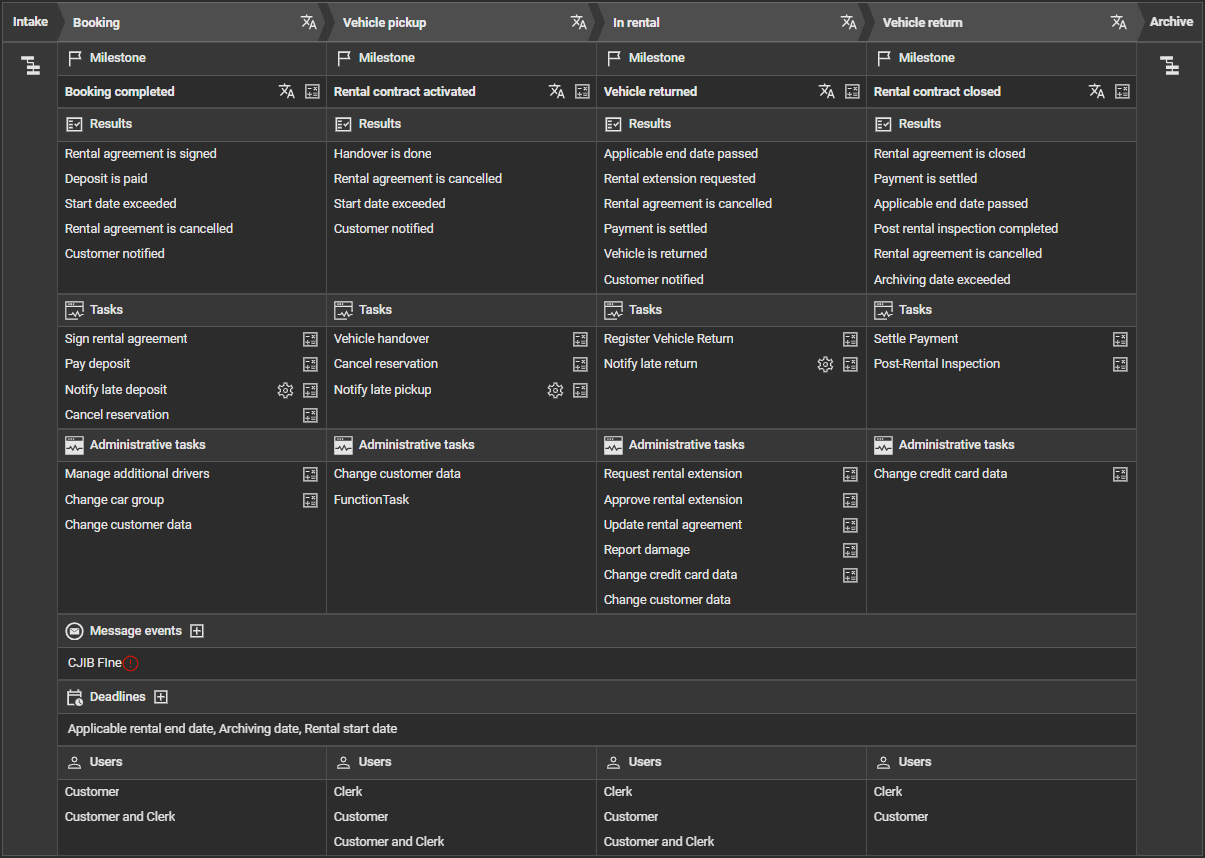
The new case overview visually supports this way of working. Processes are structured based on phases, milestones, results, and tasks.
Screenshot 2026-05-19 105822

This provides immediate insight into:

  • Which goals must be achieved within a phase.
  • What information is needed to achieve them.
  • Which actions contribute to the progress of the project.

This results in a more intuitive way of modeling, where changes can be implemented more quickly and are easier to understand.

Agent-based case management

Ready for the Future

This new approach to modeling aligns well with the rise of AI agents and agentic workflows. Because processes in Blueriq 19 are designed to be goal-driven and data-driven, it becomes clear not only which tasks need to be performed, but also under what conditions and for what purpose.

As a result, tasks can be carried out more easily by both human knowledge workers and intelligent agents. The case engine continuously determines, based on current case data, which actions are possible. This makes it easier to automate parts of processes in a controlled manner and to safely integrate AI agents in a context-driven way, into operational processes.

Bridge the gap between business and IT

For organizations, this new approach to modeling means, above all, greater agility. Processes can be adapted more quickly when legislation, policies, or customer requirements change. Because models are more functional and easier to read, collaboration between business and IT becomes simpler and more effective. At the same time, the platform’s native support ensures that less customization and fewer technical workarounds are needed.

The result is a development process that not only moves faster but also remains more manageable as solutions grow in size and complexity.

DSC08261-featured

Would you like to try data-driven modeling, too?

Please contact Yuri for a demo, a detailed explanation, or to explore together how Blueriq can help you set up your business processes.


Contact Schedule an appointment
Yuri
Versluis
Managing Director, Platform

Ask Yuri your question

He will respond within a few days.